July 2022 Update - Our latest publication and ASM 2022

Last week was a great week for the Ferrari lab. First and foremost, our latest paper, spearheaded by Nicole Benaud, was published in Extremophiles. Titled, “Soil substrate culturing approaches recover diverse members of Actinomycetota from desert soils of Herring Island, East Antarctica,” the paper highlights the promise that cold-adapted bacteria of Antarctica have as targets in further research into natural products. Click here to read it online.

Screenshot of Nicole’s announcement on Twitter. Click here to see it and her summary of the paper.

Secondly, the annual ASM conference took place last week and, as expected, it was a fantastic experience for the entire Ferrari lab. Words can’t express how refreshing it was to, finally, after two long years, be able to attend such a large, in-person event. A number of members were given the opportunity to proudly share their work, especially Angelique and Dana, who gave live seminars. Thank you to everyone who took the time to talk with our lab members and discuss the research they presented; we always relish the opportunity to talk about the implications of our work and to hear feedback from others members of the scientific community.
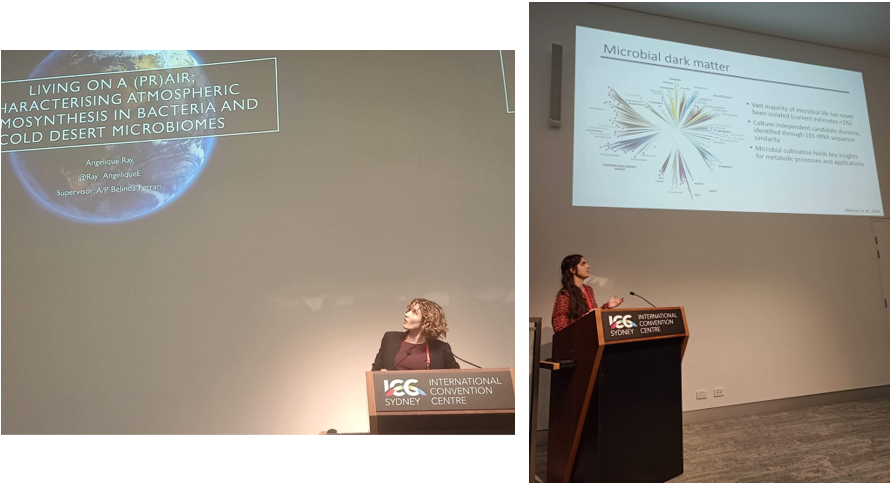
Angelique (left) and Dana (right) presenting their research at ASM.

That’s all for now, but be sure to follow Belinda @ferrari_belinda on Twitter to stay up-to-date with the Ferrari lab. The year is only halfway done and we have some exciting things in the works that we hope to share before the end of 2022.
Art meets Science

Ah microbes, beloved by ecologists, biochemists and now… photographers? Check out these stunning images captured by two of our budding photographers here at the Ferrari Lab.

Unidentified Antarctic Fungi, Image by Dr Nicole Benaud.

Streptomyces INR7, by HDR candidate Carolina Gutierrez Chavez

For the original post featuring the Antarctic fungi check out Dr Nicole Benaud on twitter @BenaudNic,

for more info on the Streptomyces captured by Carolina check out the original post on The Illuminators website https://www.edi.unsw.edu.au/the-illuminators.

A Day at the Herbarium

InBLOOM exhibit (main) photograph by Alinta Furnell, Possum (inset) photograph by Alinta Furnell, Just keep sciencing (inset) photo by Nicole Benaud, Herbarium collection (inset) photograph by Royal Botanic Gardens Sydney.

InBLOOM exhibit (main) photograph by Alinta Furnell, Possum (inset) photograph by Alinta Furnell, Just keep sciencing (inset) photo by Nicole Benaud, Herbarium collection (inset) photograph by Royal Botanic Gardens Sydney.

We had a wonderful excursion to the Royal Botanical Garden Sydney, where Director of Research & Chief Botanist Brett Summerell gave us a tour of the labs and the Herbarium. We met the herberium’s resident sight-impaired possum, viewed some of the precious collection dating back to 1770 collected by Joseph Banks, and watched the process of photographing and cataloguing currently being performed for the large collection.
We are very excited to working with Brett on a project to characterize some of our Antarctic fungal isolates.
More info on the Botanic Gardens Herbarium can be found on their website: https://www.rbgsyd.nsw.gov.au/Science/Branch-Out/What-is-a-herbarium

The Ferrari Lab have recently become members of UNSW’s Evolution & Ecology Research Centre

Welcome to A/Prof Belinda Ferrari and her team, Nicole Benaud, Kate Montgomery, Angelique Ray, Sin Yin (Nicky) Wong, Devan Chelliah, Eden Zhang, Carol Gutierrez Chavez, Dana Tribbia, and Jessica Dai as the Centre’s newest members. Belinda is currently an ARC Future Fellow, Deputy Head of School, and the Director of Research for the School of Biotechnology and Biomolecular Sciences. She is also a member of the Centre for Marine Science and Innovation. Belinda’s research area is environmental microbiology specialising in Antarctic soil biodiversity and performs discovery-based and applied research. She is passionate about integrating single cell technologies with innovative cultivation methods and genomics to uncover the diversity and functional capacity of uncharacterised soil microbiomes. By doing so, her team recently discovered a novel carbon fixation process where cold adapted bacteria literally ‘live on air’. They coined this microbial-based process ‘atmospheric chemosynthesis’ and published these findings in the prestigious journal Nature. Read the article on it here. The team also works on using microbes as indicators of soil health, for the assessment of ecosystem recovery during bioremediation and for developing site-specific ecotoxicity assessments. Belinda’s future goals are to continue to challenge our understanding of the nutritional limits required for life, while training the next generation of confident scientists.

Congratulations to Kate, Eden and Angelique for earning Antarctic Science Foundation grants

Antarctic PhD students.png

Three Ferrari Lab PhD candidates; Angelique, Eden and Kate, have been awarded grants from the Antarctic Science Foundation. These grants aim to support Australia’s most promising young Antarctic scientists to continue their studies in the face of financial stress brought on by the COVID-19 pandemic.

https://antarcticsciencefoundation.org/blog/2020/9/15/covid-grants-awarded

Congratulations to Nic for receiving an Antarctic Science Bursary for 2020

Streptomyces isolated from Antarctic soil. Photo by Nicole Benaud

Streptomyces isolated from Antarctic soil.
Photo by Nicole Benaud

Nicole has been awarded an Antarctic Science International Bursary for 2020, which will enable her to extend her research into potential anticancer and antimicrobial natural products from Streptomyces (pictured) and Kribbella bacteria isolated from eastern Antarctic soils.

https://www.antarcticsciencebursary.org.uk/research-activities/